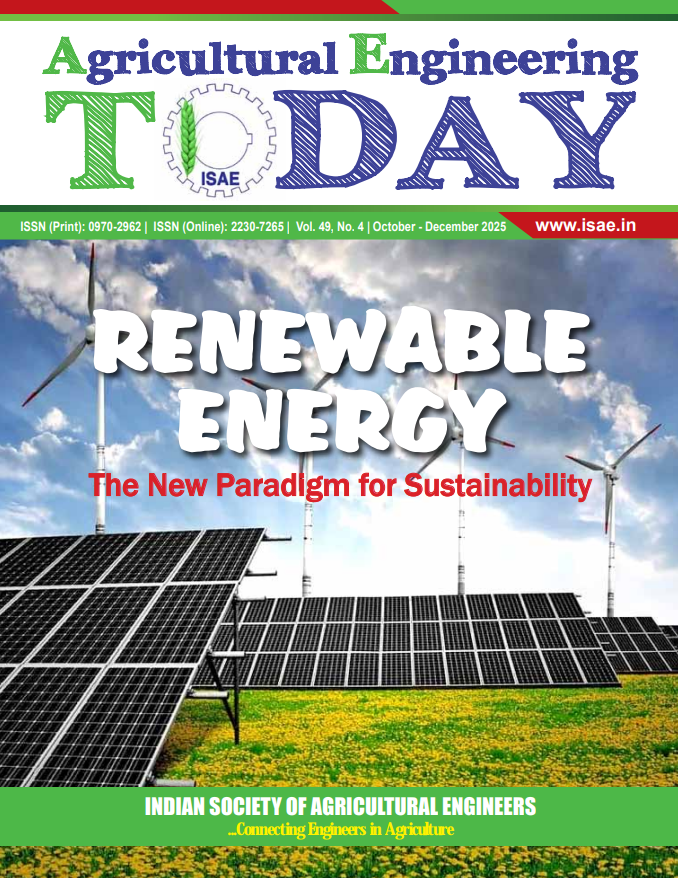
Renewable Energy: A New Paradigm for Growth
DOI:
https://doi.org/10.52151/aet2025494.1888Abstract
Agriculture is the backbone of India’s rural economy, employing nearly 42% of the workforce and accounting for about 85% of freshwater withdrawals. Coverage of irrigation area increased between 2016 and 2021 from 49.3 to 55% of gross cropped area. Irrigation reliability, however, depends on access to affordable and dependable energy. The agricultural sector in India consumes nearly 20% of total electricity and a large share of diesel fuel, primarily for irrigation pumping and this has led to high fiscal stress, inefficient water use, and unsustainable groundwater extraction. For decades, expansion of irrigation relied on canals, diesel pump-sets, and heavily subsidized grid power. As climate variability, groundwater depletion, and energy subsidies strain both ecosystems and state budgets, renewable energy (RE) offers a transformative opportunity to decouple irrigation growth from fossil dependence. The renewable energy transition aligns with India’s commitments under the Paris Agreement and the Nationally Determined Contributions targeting 50% of cumulative power capacity from non-fossil sources by 2030. In agriculture, it promises a dual dividend: energy self-sufficiency for irrigation and decarbonization of a high-emission sector. The adoption of RE technologies, especially solar photovoltaic (PV) irrigation pumps, agrivoltaics, canal-top and floating solar, and biomass-based microgrids— marks a structural shift toward sustainability and circular resource use.
Downloads